
Ostrava, 15 April 2026 – The Czech Republic is entering the next phase of building its quantum communication infrastructure. It now boasts a complete quantum backbone network connecting Prague, Brno, and Ostrava, through which shared information should flow securely, taking into account the potential risks associated with the advent of quantum computers. The Czech side presented the results of the pilot operation on 14 April 2026, at the ceremonial launch of the Czech Quantum Communication Infrastructure (CZQCI). The event was attended by representatives of the European Union, foreign consortia, government agencies, research institutions, and industry.

The CZQCI project is part of the pan-European EuroQCI initiative, which aims to create an extremely secure communication infrastructure based on quantum technologies. The goal is to begin building a complete communication network after 2030, connecting institutions of nation-states and the European Union, critical infrastructure, and selected private entities. The launch of the Czech national backbone network is the first step for the Czech Republic. A broad consortium of academic and research organisations, communication infrastructure providers, and partners from government, the armed forces, and the cybersecurity sector is participating in the initiative.
CyberSecurityHubcz has taken on the coordination and integration of the project at the national level, providing key expertise, connecting individual stakeholders, and ensuring alignment with European initiatives. “Building quantum communication infrastructure is a long-term and complex process that requires close cooperation across the academic sphere, research organisations, government, and industry. CZQCI is the technological foundation from which the secure communications of the future can grow, as well as a space for educating a new generation of experts in the field of quantum technologies. The newly developed know-how and expertise of the technical teams are key here,” said Jan Bouda, CZQCI project coordinator from CyberSecurityHubcz.
CZQCI will provide:
- A test backbone network linking Prague, Brno and Ostrava, which will serve as the first quantum communication network spanning long distances.
- Educational programmes in the field of quantum communications for both the general public and experts across sectors that can benefit from the advantages of quantum communication, particularly in cyber security, communication networks and optical communications.
- The opportunity to test real quantum communication through trial access to the backbone network for interested partners from both the public sector and industry.
- A laboratory for education and advanced testing, equipped with a representative range of different quantum technologies.
The project brings together a broad consortium of partners coordinated by CyberSecurityHubcz, including CESNET, the Czech Technical University in Prague, Palacký University Olomouc, the Institute of Scientific Instruments of the Czech Academy of Sciences, Brno University of Technology, and VSB – Technical University of Ostrava. A key role in the infrastructure is also played by IT4Innovations National Supercomputing Center at VSB – Technical University of Ostrava.
“Data security requirements are becoming an increasingly discussed topic, particularly in the context of the remote processing of sensitive data. Data transfers between high-performance supercomputers and their data sources therefore require fundamentally new approaches to security. Quantum communication infrastructure is thus becoming an essential complement to the operation of, for example, AI Factories, which are currently being developed across Europe,” adds Vít Vondrák, Director of IT4Innovations.
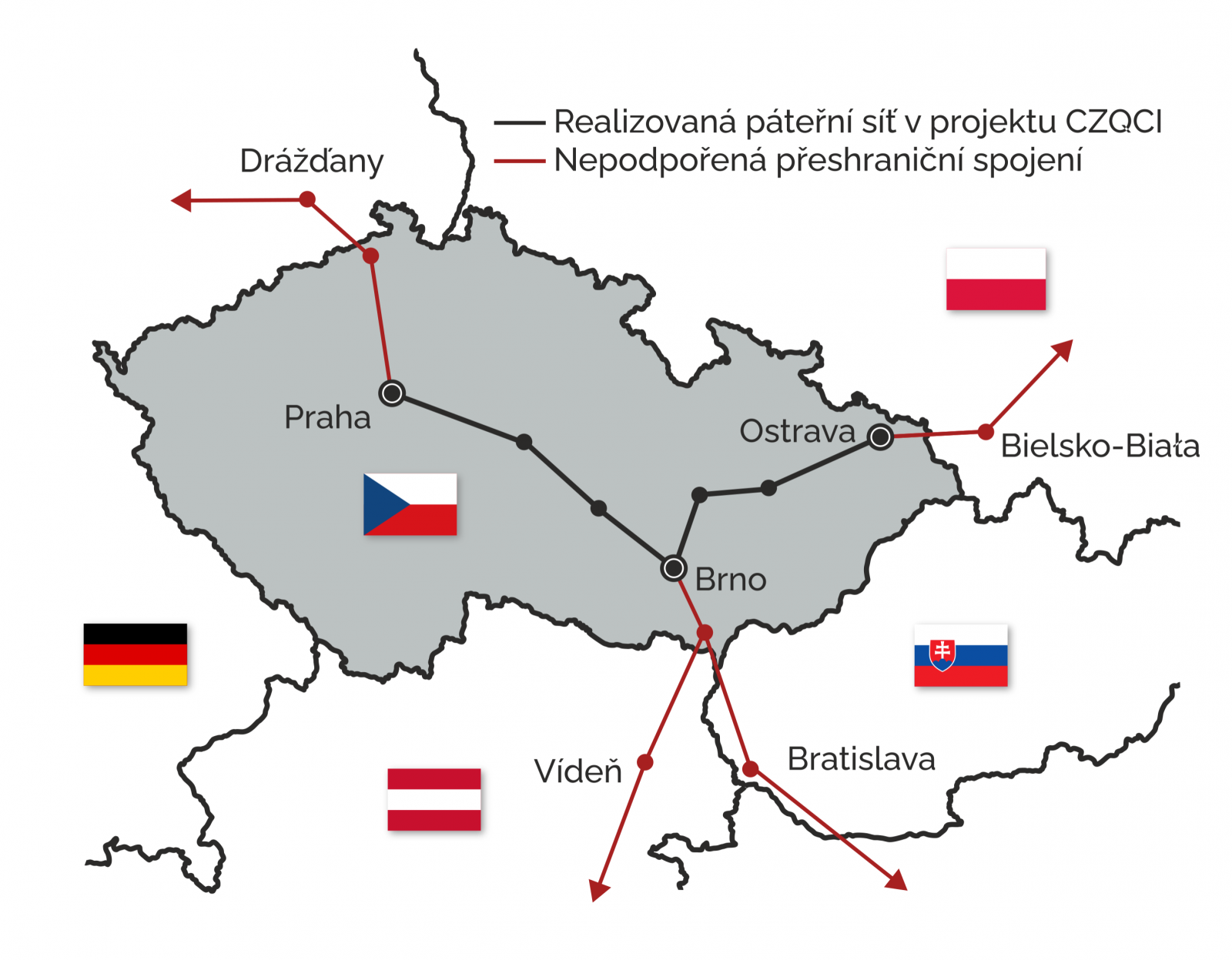
Map of the backbone network of the National Quantum Communications Infrastructure | Author: CyberSecurityHub
(Black lines indicate the backbone network implemented under the CZQCI project; red lines indicate cross-border connections outside the scope of the project.)

The CZQCI project is funded by the Digital Europe Programme under grant agreement No. 101091684. The project is co-financed by the European Union within the framework of NEXT GENERATION EU.