
How do massive black holes migrate to the centres of galaxies, and how can their movement be modelled as accurately as possible? An international team of scientists sought answers to these questions in a study published in the journal *Astronomy & Astrophysics*. Scientists from IT4Innovations National Supercomputing Center also contributed to the research.

Advanced Simulations for Deeper Insights into the Universe
Researchers investigated how supermassive black holes move within galaxies and what causes them to gradually “sink” toward the centre of their host galaxy. The authors focused on a phenomenon known as dynamic friction, in which surrounding matter—such as stars or dark matter—slows down the black hole’s motion, much as drag decelerates an object's motion.
The research team combined analytical calculations with numerical simulations. First, they developed a theoretical model describing the expected motion of the black hole and then validated it through simulations at varying levels of detail. It turned out that the results can vary significantly depending on the accuracy of the simulation and the methods used.
A key result of the study is an improved Dynamical Friction Correction (DFC). The authors have enhanced it by providing a more accurate estimate of the mass density in the immediate vicinity of the black hole, enabling the simulations to better capture its actual motion even at lower computational resolutions.
Czech footprint in space exploration
Petr Strakoš and Milan Jaroš from IT4Innovations also contributed to the study. They were primarily involved in processing the results of simulations run on the Leonardo supercomputer at the Italian Cineca centre and in their subsequent visualisation on the Karolina supercomputer operated by IT4Innovations.
“Advanced simulations are now one of the main tools of modern astrophysics. They allow us to study processes that cannot be observed directly. That is precisely why methods capable of visualising the results clearly and accurately are also important in this field—and that was our task,” said Milan Jaroš of the IT4Innovations Infrastructure Research Lab.
Key improvements made
The study’s results showed that the new method improves the accuracy of simulations of black hole motion in galaxies and significantly enhances their agreement with theoretical predictions. Unlike older methods, it works reliably even at lower computational resolutions and in cases where the black hole is less massive than the surrounding particles in the simulation—a situation that had previously been troublesome. As a result, it enables more realistic and efficient modelling of galaxy evolution, black hole mergers, and the generation of gravitational waves.
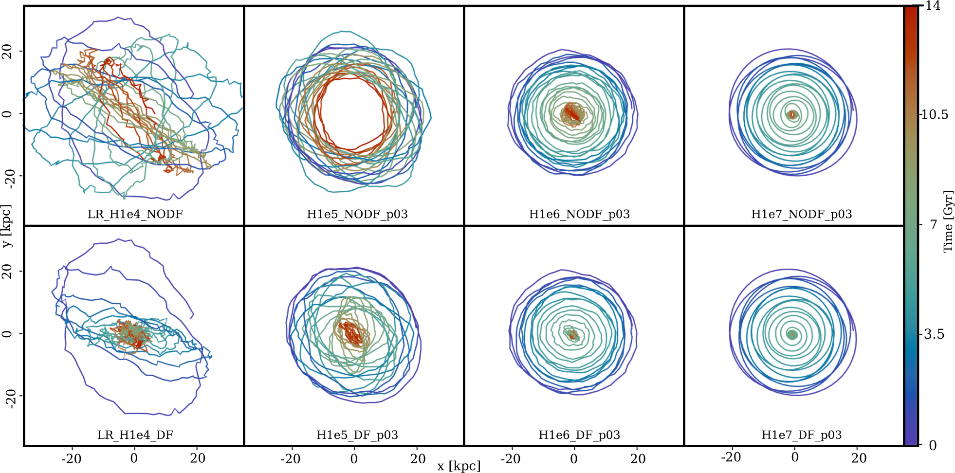
Figure: The trajectory of a black hole in simulations with progressively increasing resolution.
The figure visualises the motion of a black hole toward the centre of a galaxy across simulations with varying levels of detail. Each panel represents an increasing level of resolution from left to right. The spiral illustrates the trajectory of the black hole from its initial position toward the centre of the galactic halo—the region that surrounds the galaxy and holds it together through gravity. The higher the simulation accuracy, the more stable the results and the closer they align with the theoretical model.
The authors wanted to demonstrate that at lower resolutions, the motion of a black hole can be inaccurate, slower, and more chaotic, whereas at higher resolutions, the results improve. Furthermore, their dynamic friction correction (DF correction) helps achieve the correct behaviour even without an extremely detailed simulation.
Scientific papers
Dynamical friction and massive black hole orbits: Analytical predictions and numerical solutions: https://doi.org/10.1051/0004-6361/202556054
This work was supported by the SPACE project under grant agreement No. 101093441. The project is supported by the European High-Performance Computing Joint Undertaking (EuroHPC JU) and its members, including additional funding by the Ministry of Education, Youth and Sports of the Czech Republic (ID: MC2304).
This research project was carried out with support from the Ministry of Education, Youth and Sports of the Czech Republic through the e-INFRA CZ project (ID: 90254)