
What can a quantum computer do, and what could it be useful for in the future? Researchers from Czech research organisations are among the first to seek answers, having gained access to VLQ, the first quantum computer installed in the Czech Republic. Using real quantum hardware, they will test applications including detecting AI-generated voice deepfakes, simulating molecules important for drug development, and analysing power grids. At the same time, researchers are gaining hands-on experience with a technology that differs fundamentally from classical supercomputers in many respects.

Through the 37th Open Access Grant Competition of IT4Innovations, 16 projects from Czech research institutions have gained access to the VLQ quantum computer. Successful applicants include researchers from the Czech Academy of Sciences (CAS), VSB – Technical University of Ostrava, Charles University and Brno University of Technology.
“Launching the first projects is an important step towards giving scientists experience with real quantum hardware. Current quantum computers do not replace classical supercomputers, but they open up opportunities to develop new algorithms, applications and expertise that are important for advancing quantum technologies,” says Branislav Jansík, Director of Supercomputing Services at IT4Innovations.
From AI-generated voices to power grids
One of the projects is led by Anton Firc from Brno University of Technology, who is exploring the potential of quantum methods for detecting so-called audio deepfakes, that is, voice recordings generated using artificial intelligence. He will compare quantum-classical models with conventional machine-learning methods and assess whether they can more reliably identify synthetic voices.
Van Binh Henri Vu from IT4Innovations is also exploring the combination of artificial intelligence and quantum methods. His project focuses on analysing financial transactions and identifying patterns associated with suspicious behaviour, such as money laundering.
Ivan Zelinka from the Faculty of Electrical Engineering and Computer Science at VSB-TUO will also explore the use of artificial intelligence – to design and optimise quantum algorithms. His QUASION project aims to contribute to the development of tools that could enable AI to play an active role in designing quantum algorithms in the future, much as AI already assists programmers in developing classical software.
Other researchers will use VLQ to simulate molecules and materials. Przemyslaw Karol Grenda from Charles University will combine artificial intelligence, quantum chemistry, and quantum computing to simulate enzymes involved in drug processing in the human body. Libor Veis from the J. Heyrovsky Institute of Physical Chemistry of the CAS will also focus on the electronic structure of molecules. At VLQ, he will test quantum-classical methods for calculating molecules with complex electronic correlations and investigate their accuracy and resilience to noise in current quantum computers. Maximilián Lamanec from IT4Innovations will use both quantum and classical computing to refine simulations of Auger spectra, which help reveal the electronic structure of molecules. On VLQ, he will test new quantum-classical approaches for calculating the electronic states of molecules. Martin Friák from the Institute of Physics of Materials of the CAS will investigate the impact of noise in current quantum computers on calculations of the electronic structures of crystalline materials.
Pavel Baláž from the Institute of Physics of the CAS will explore the use of artificial intelligence to characterise quantum states more efficiently and to obtain reliable information from fewer measurements.
So, how do you actually work with a quantum computer?
Scientists do not access VLQ directly. Instead, they prepare quantum algorithms and circuits, submit them for processing, and then analyse the obtained results. Michal Belina from IT4Innovations is also gaining his first experience with VLQ. In his project, he is exploring the potential of quantum algorithms for analysing power grids.
He shared his first experience with VLQ and what goes into preparing a calculation in an interview:
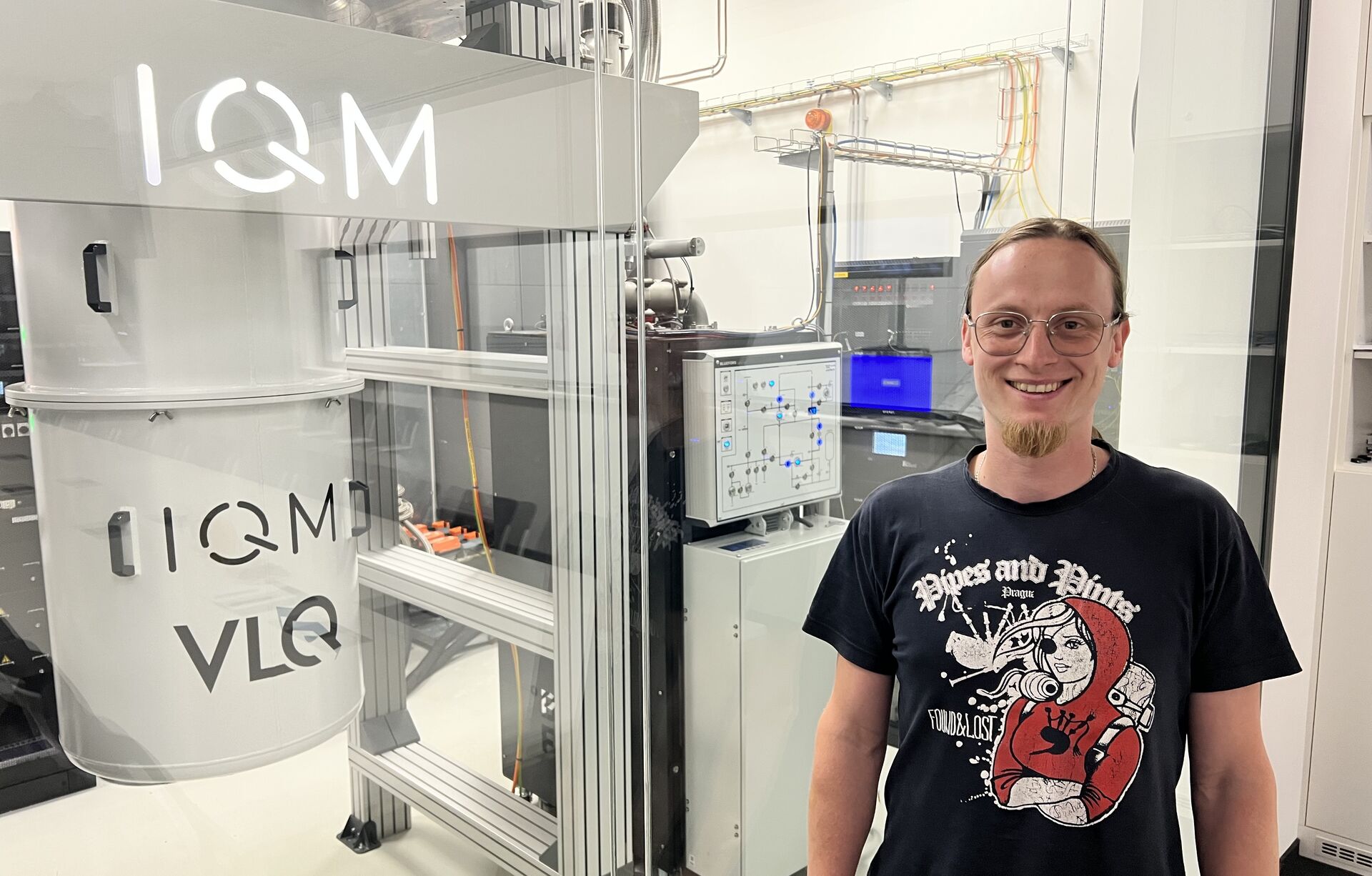
What does the journey from an idea to the first calculation on VLQ look like? What does a researcher have to do before their task reaches the quantum chip?
MB: In principle, the workflow does not differ from tasks run on classical supercomputers. It starts with an idea. By an idea, we usually mean two things: a problem and a proposed solution. The solution should offer an advantage over existing approaches, such as saving time, reducing costs, or reducing computational demands.
We then translate the idea from a mathematical formulation into a specific piece of code or programme. This needs to take into account the type of computer on which the problem will be solved. We then test whether the proposed solution can solve the problem and how efficiently it does so. For quantum solutions, this testing is first carried out on a quantum computer simulator. Smaller quantum computers can be simulated on a desktop computer, while a supercomputer can be useful for larger simulations. This allows us to test whether the proposed solution works and helps us estimate the computational time required for larger systems.
The next step is to gain access to VLQ. One option is through a grant competition open to all employees of research organisations in the Czech Republic. Once I am allocated computing time, I receive access credentials for VLQ, including web access that allows me to monitor the quantum computer's current state and my current and completed computational tasks.
I also receive an access token, essentially a key that I use to sign my computations so that it is clear they belong to me. This is necessary for tracking the amount of computing time used. I then submit these signed instructions to the queueing system, which controls when and which computational task runs on VLQ and records the computing time consumed.
What does the working environment of someone preparing calculations for a quantum computer look like?
MB: I have a work laptop, on which I do all of my work practically. Specifically, I use a standard programmer’s IDE (integrated development environment) to create quantum algorithms. It helps programmers, for example, to navigate code more quickly,manage variables and in recent times to utilise the AI tools. I used Spyder for a long time, but recently I switched to Antigravity IDE.
I write quantum algorithms in Python. What is specific is the use of libraries for quantum computing. These provide objects representing quantum circuits and operations, from which I assemble specific algorithms, and subsequently translate them into instructions for particular quantum hardware, such as VLQ. These instructions take the form of very short microwave pulses.
I then run the final programme in the IDE or via the command line. After a delay that depends on the length of my algorithm and the VLQ's current workload, I receive a set of zeros and ones as the result. For example, it could show the voltage range at a node in the power grid within which the grid will still operate.
What was the first task you ran on VLQ?
MB: The very first task I ran was a test task with two objectives. First, to demonstrate how to connect to VLQ via VPN, and second, to demonstrate how effectively the VLQ quantum computer can create quantum-entangled states. Before that, I had run tasks on IBM quantum computers, but it was an abstract experience: everything runs through cloud services, and you do not know exactly where the machines are located. VLQ was different. I had seen it with my own eyes beforehand, and I could see that I was connecting to the IT4Innovations VPN and that it was not taking me to an unknown location, but simply to a machine a few doors away.
I would like to add one point: quantum computers are based on the principles of quantum mechanics – a highly counterintuitive theory which, however, works remarkably well. We’ve all come to terms with gravity in one way or another: our grazed knees from childhood are proof of that. Coming to terms with the principles of quantum mechanics, however, is considerably more difficult, because neither our knees nor our everyday experiences can help us here. But if we come into daily contact with the principles of quantum mechanics, we will begin to perceive them as one of the laws of the world in which we live. Just as naturally as gravity.What is the most surprising thing about working with a quantum computer compared with a classical supercomputer?
MB: Today’s quantum computers are experimental devices that are subject to significant error rates. Ordinary users of classical computers do not have to worry about errors in properly functioning hardware. Excel will work the same way on Monday as it does on Friday (unless, of course, there is a software problem), and you will most likely be able to play your game in the same way too. Most programmers and computer scientists also do not have to consider the error rate of individual operations performed by classical hardware. It is extremely low, and error-correcting codes exist to detect and correct any errors that do occur.
A quantum computer, however, can produce different results on Monday and Friday. Not dramatically different results, but it is common practice to save the latest VLQ statistics alongside the experiments being carried out. When comparing results from different experiments, I can also consider the state VLQ was in at the time of each experiment. For example, the error rate when reading the state of a qubit can vary by one percentage over the course of just a few days, which is quite normal. Ideally, such errors will be suppressed in the future, and we will no longer have to take them into account, but that is not the case yet.
Looking at your specific project, where could quantum algorithms help with power grid analysis in the future?
MB: Power grids are currently undergoing a radical transformation with the addition of renewable energy sources, whose output varies with the weather, increasing uncertainty in grid operations. These sources also disrupt the grid’s inherent self-regulation capabilities, which are provided, for example, by turbine-based generators in conventional power plants. Primarily, direct-current sources, such as solar panels, lack this capability. As a result, managing transmission systems requires much more detailed and faster control than it did decades ago. Our research is closely linked to the ZEUS project, which investigates community-based energy systems characterised by a large number of smaller, renewable energy sources.
In our research, we are studying the interval power flow calculation. We are interested in the boundary values at which the grid will still operate safely. Current methods are affected either by systematically narrowing the safe intervals or by scaling exponentially with grid size. We formulate the quantum approach as an optimisation problem and investigate whether it can search more efficiently for the worst-case operating conditions. On VLQ, we will test this approach on the smallest power grid models and compare the results with classical methods.
More about the first selected projects on the VLQ quantum computer: https://www.it4i.cz/en/research/users-and-their-projects/complete-list-of-projects-of-our-users