
Researchers at IT4Innovations National Supercomputing Center used machine learning methods to analyse children's movement data. The goal was to determine whether data collected by a single sensor attached to the body could be used to identify different types of physical activities and reveal similarities among them. The results may find applications in the future in sports training, physical education, and physiotherapy.

The study involved 81 children aged 9 to 11 who completed a series of physical tasks, including shuttle runs, climbing, and jumping over a bench. Throughout the testing, movement was recorded using a single sensor placed between the shoulder blades. The sensor measured acceleration and rotational movement of the torso, providing researchers with a comprehensive dataset on the progression of each activity.
Machine learning played a key role in the analysis. The researchers used the XGBoost algorithm, which automatically selected the most important features from a large set of calculated features to distinguish between individual activities. “It turned out that incorporating machine learning methods into the feature selection process significantly improves the system’s ability to recognise and categorise physical activities,” explains Radek Halfar of IT4Innovations.
The selected features were then used to create a so-called Self-Organizing Map, which groups similar movement patterns close together. This is not a new method, but rather a proven machine learning tool that the research team used to create a clear map of the relationships between individual exercises. The model was able to distinguish the monitored physical activities with more than 90 per cent accuracy.
According to the authors, a similar approach can help in selecting appropriate exercises for various groups of children or patients. Thanks to its ability to identify activities with similar movement patterns, it could contribute to the design of more varied training programs, the monitoring of motor development, and the assessment of progress during physiotherapy. For example, if a child or patient is unable to perform a specific exercise due to a health limitation, the model can help identify an alternative activity that addresses similar movement challenges, thereby maintaining the desired training or physiotherapy effect.
Figure: A similarity map of physical activities created using the Self-Organizing Map (SOM) method
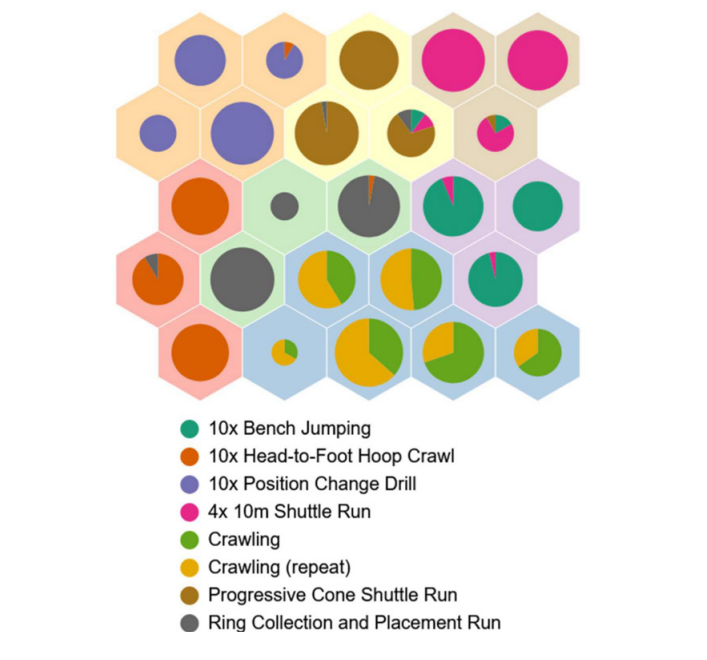
The map shows which exercises the body performs in a similar manner and which, on the other hand, employ completely different movement strategies. The colour-coded areas represent groups of biomechanically similar activities, while the distance between them reflects the degree of their differences.
For example, the Shuttle Run and the Progressive Cone Shuttle Run—runs characterised by changes in direction—ended up close to each other at the top of the map. SOM recognised that their movement dynamics are similar. In contrast, the Head-to-Foot Hoop Crawl—which mainly involves bending the torso and working in place—and the Shuttle Run—which includes sharp accelerations, decelerations, and changes in direction—ended up on opposite sides of the map, as the sensor on the back recorded completely different movement patterns.
Scientific papers
Essential time series characteristics for human motion analysis based on Self-Organizing Map clustering: https://gymnica.upol.cz/artkey/gym-202601-0004_essential_time_series_characteristics_for_human_motion_analysis_based_on_self-organizing_map_clustering.php
The study “Essential time series characteristics for human motion analysis based on Self-Organizing Map clustering” was conducted in collaboration with researchers from IT4Innovations and the Institute of Active Lifestyle at the Faculty of Physical Culture, Palacký University in Olomouc.
This work was supported by the Ministry of Education, Youth and Sports of the Czech Republic through the e-INFRA CZ (ID: 90254) project.