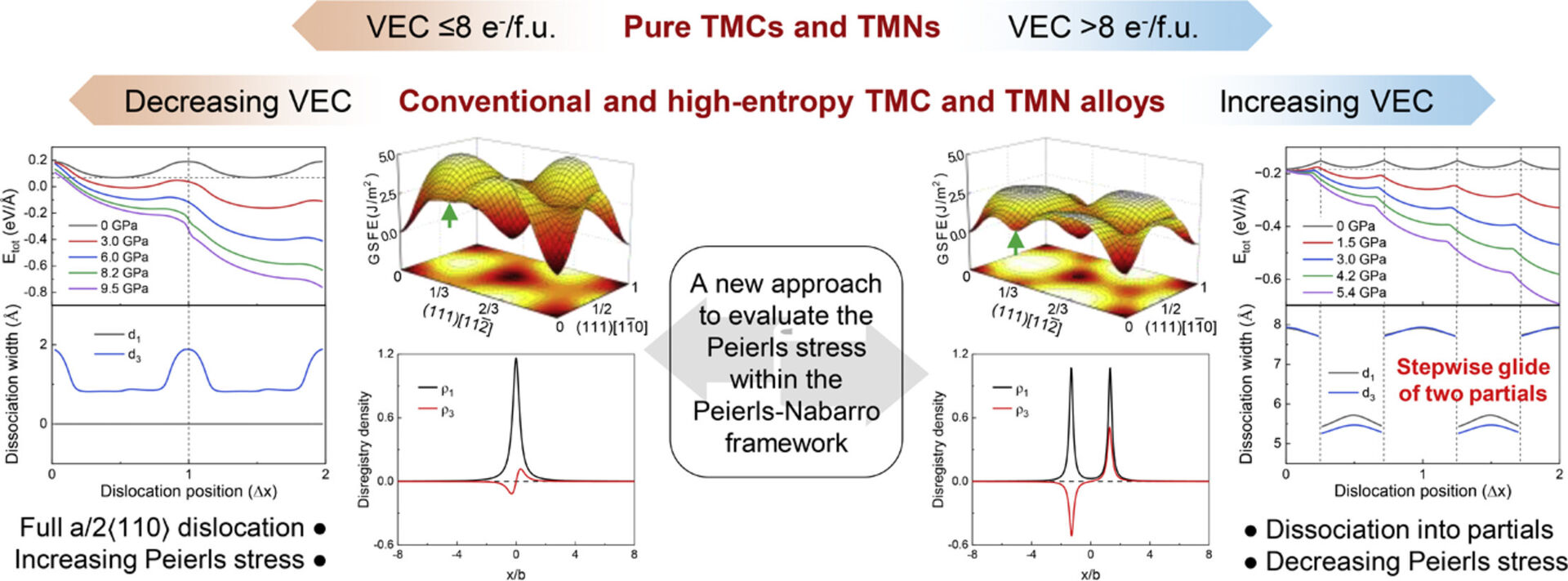
An international team of researchers from Czech and Japanese universities, including Dominik Legut from IT4Innovations at VSB – Technical University of Ostrava, has shed light on what influences the deformation of transition metal carbides and nitrides at the atomic level. Valence electrons play a key role. Their number affects the movement of defects within the crystal structure and, consequently, the mechanical behaviour of the material. The research, published in the scientific journal Acta Materialia could help enable the targeted design of new materials and reduce the need to find suitable compositions through trial and error.
Transition metal carbides and nitrides are known for their high hardness, high melting points, and resistance to wear, corrosion and high temperatures. They are used, for example, as hard protective coatings for cutting and machining tools or in components exposed to demanding operating conditions. Their weakness, however, is their inherent brittleness – under load, they may crack rather than deform.
One way of modifying their mechanical properties is to alter their chemical composition by adding other elements, a process known as alloying. This approach is also used to reduce the brittleness of these materials. Until now, however, it has not been sufficiently clear what exactly happens in their crystal structure when their composition is changed, and why this subsequently affects their mechanical behaviour.
“We want to retain the advantages of these materials, such as their hardness and resistance, while at the same time reducing their brittleness. Our results show that the number of valence electrons is one of the key factors. This allows us to better understand how changing the chemical composition affects the behaviour of the material and to search for suitable compositions in a much more targeted way,” explains Dominik Legut from IT4Innovations.
The scientists focused on so-called dislocations – defects in the regular arrangement of atoms in a crystal, whose movement is crucial for the deformation of a material. The more easily they can move through the crystal, the more readily the material can deform under load. The team investigated this mechanism in transition metal carbides and nitrides and their alloys, including high-entropy alloys, which combine several different elements.
“Using calculations based on density functional theory and the SVPN (semidiscrete variational Peierls–Nabarro) method, we were able to track changes in the structure of dislocations and the stress required for them to move. This allowed us to compare changes in the electronic structure with whether and how easily dislocations can move through the material,” adds D. Legut.
The calculations revealed that, above a certain number of valence electrons, a full dislocation can split into partial dislocations. These then move through the crystal sequentially, significantly reducing the stress required for their movement and facilitating plastic deformation of the material. At a lower number of valence electrons, the dislocation remains undissociated and its movement is more difficult.
The team observed the same relationship in both conventional and high-entropy alloys. Adding elements with a higher number of valence electrons promoted the splitting of dislocations and facilitated their movement. Elements with a lower number of valence electrons had the opposite effect.
The research therefore helps explain why even a change in chemical composition can affect the mechanical properties of these materials. The number of valence electrons could serve as one of the guiding factors when searching for suitable compositions for new materials – for example, materials that retain high hardness and resistance while being better able to deform under load rather than crack, making them more ductile.
Research article
Valence-electron-associated dislocation dissociation and glide mechanisms in transition-metal carbide and nitride alloys
https://doi.org/10.1016/j.actamat.2026.122505