
Why does some unverified information on social media continue to spread, whilst other information gradually disappears? An international team of scientists, including researchers from IT4Innovations, has developed a mathematical model that examines how rumours and debunking information spread and the roles that user memory, response time, and the unpredictability of human behaviour play in this process. The study was published in the journal Scientific Reports.

Four user groups and multiple simultaneous factors
To ensure the model closely reflects real-world social media behaviour, the researchers divided users into four groups: those who are encountering the information for the first time (newcomers, susceptible); active spreaders of the information; users or organisations seeking to refute it (counter-rumour spreaders, inhibitors); and those who are no longer interested in its further dissemination (stiflers). The model describes how users may transition between these groups after encountering a rumour.
The resulting model also links three factors that previous approaches have often studied in isolation: long-term memory, response delay, and random changes in user behaviour. It therefore takes into account that our current response also depends on what we have encountered previously, that verifying or responding to information takes some time, and that people’s behaviour on the internet is not entirely predictable. It is precisely the integration of these three factors into a single model that is one of the study’s main contributions.
When a rumour persists and when it dies down
One of the key parameters of the model is the reproduction number R₁, which, much like in infectious disease spreading models, indicates whether a rumour can persist in the system over the long term. If its value is less than one, the spread gradually dies out. If it exceeds this threshold, the rumour may continue to persist.
The researchers also investigated which parameters influence a rumour’s capacity to spread over the long term. The results showed that a higher rate of spread and a larger proportion of users who believe the rumour and start spreading it further increase the reproduction number R₁. Conversely, blocking or reporting those who spread it reduces this value. Separate simulations also showed that time plays a significant role: the longer it takes to verify the information or to intervene to curb its spread, the more the rumour’s subsequent development may change, and the more difficult it becomes to limit its spread.
Practical applications
The model can serve as a virtual environment for testing various scenarios. “For example, it allows us to examine how the situation changes if there is a faster response to unverified information or if its further spread is curbed more effectively. Such simulations can help us better understand which factors to focus on when countering misinformation and rumours, and when intervention is most effective,” says Marek Lampart from IT4Innovations, adding: “However, it is not a tool designed to predict the fate of a specific social media post. Rather, it is a mathematical model that helps isolate individual factors, test their combinations, and better understand the mechanisms that determine whether a rumour will persist or gradually die out.”
In addition to Marek Lampart, Head of the Quantum Computing Lab, Ali Raza and Umar Shafique, who work in the same laboratory, also contributed to the research on behalf of IT4Innovations.
Chart – Factors Fuelling and Suppressing Rumour Spread
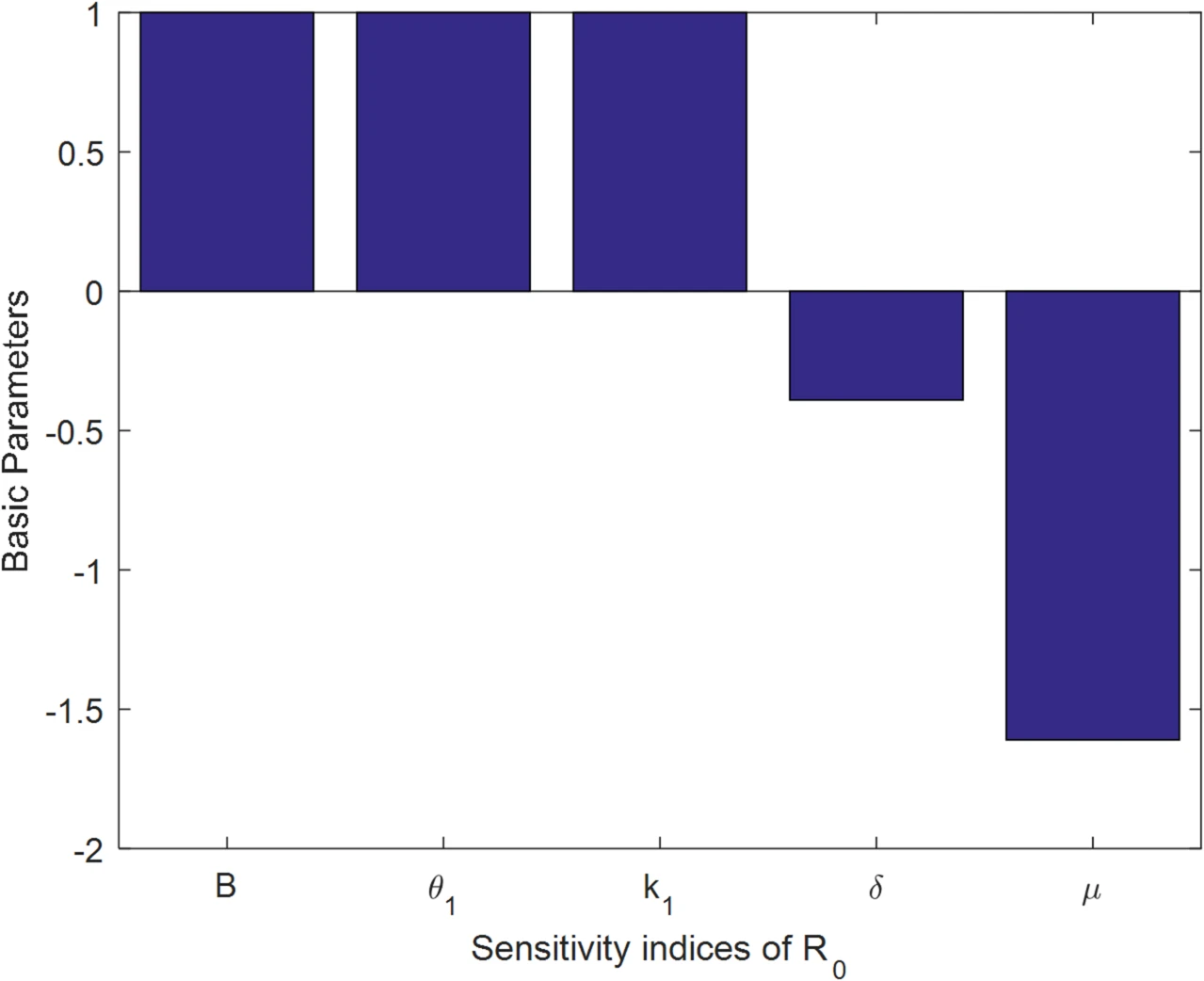
where B means Influx of new users; θ₁ – Proportion of users who believe the fame and start spreading it; k₁ – Rumour transmission rate; δ – Blocking or reporting of spreaders and μ – User exit rate.
The sensitivity analysis shows that some factors increase a rumour’s capacity to persist, whilst others, on the contrary, reduce it.
Values above zero increase its persistence, whilst values below zero reduce it. The results thus help identify which mechanisms it is worth targeting when seeking to limit the spread of unverified information. For example, a higher rate of blocking or reporting of spreaders in the model reduces the reproduction number R₁, thereby limiting the rumour’s capacity to spread further. Conversely, a higher rate of spread or a larger proportion of users who believe the rumour and begin sharing it increases the value of R₁.
Original scientific article
Rumor and counter-rumor dynamics in a stochastic delay-fractional framework: a GL-NSFD approach: https://www.nature.com/articles/s41598-026-49743-1#data-availability
This work was supported by the Ministry of Education, Youth and Sport of the Czech Republic through e-INFRA CZ (ID: 90254), and by the European Union as part of the REFRESH project – Research Excellence for Regional Sustainability and High-tech Industries, No. CZ.10.03.01/00/22_003/0000048, via the Just Transition Operational Programme, and also by SGS grant No. SP2025/049 from VSB – Technical University of Ostrava, Czech Republic.